

Two launches in the space of a few weeks tell you where the money is going. Instinct, a personal AI assistant with fourteen employees, raised a billion dollars at a ten billion dollar valuation barely a month after it launched, and the product was still invite-only. A couple of weeks later, Saru launched out of a16z’s Speedrun program, pitching itself as the AI concierge for consumer brands, with “an entire AI workforce” behind every customer conversation.
[Note - I am using Instinct and I absolutely love it, but that’s for another story]
One is built for the consumer, the other for the brand. Both are agents, and both are being valued as if the agent were the asset. Neither launch post says a word about where the data comes from.
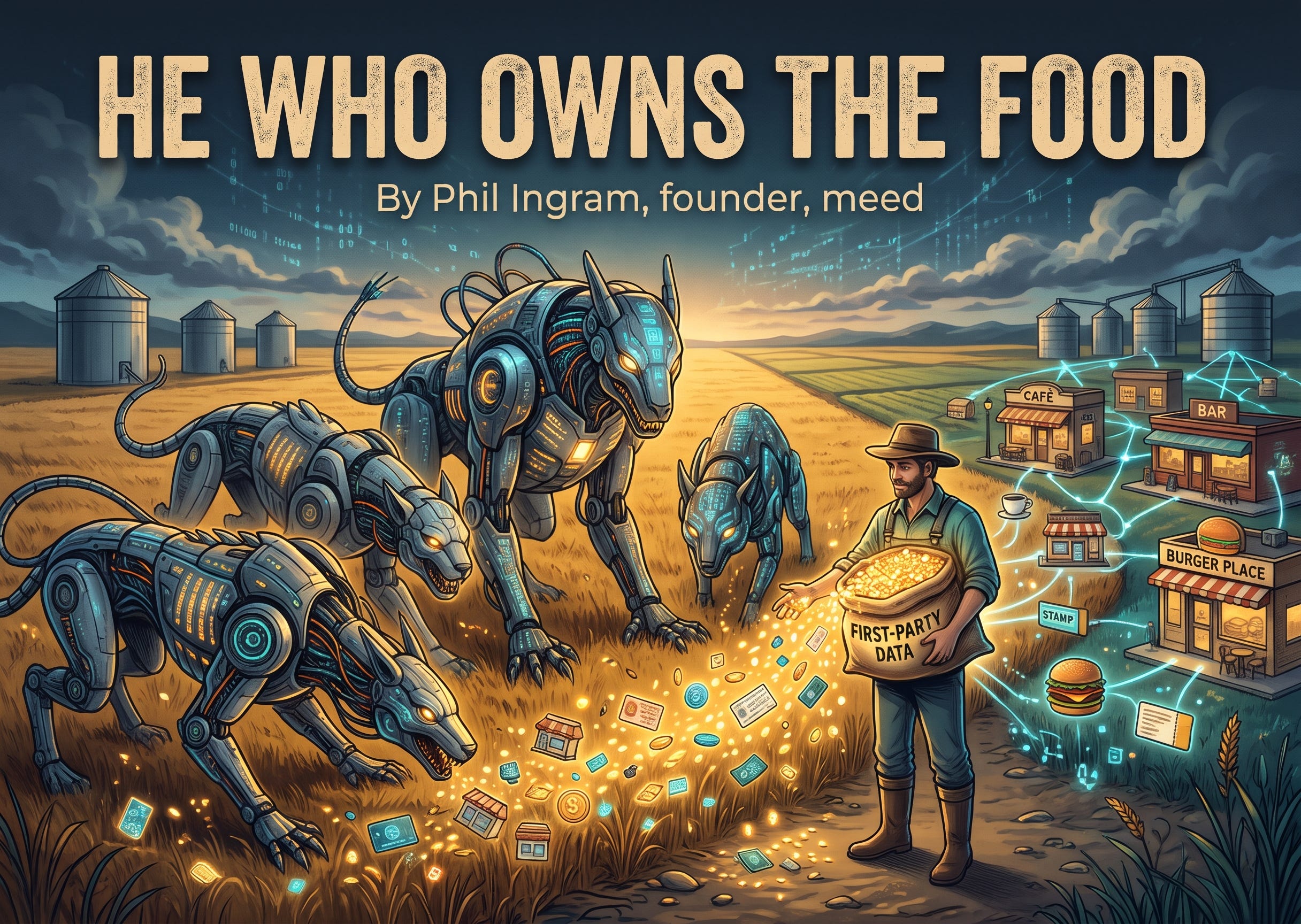
That is the gap this piece is about. Agents are the animals in this story: fast, expensive to breed, and completely dependent on being fed. The feed is structured, permissioned data about what real people actually do. The interesting question in agentic commerce is not who builds the cleverest animal.
It is who owns the food.
What an agent actually eats
Strip away the demos, and an agent is a system that takes actions on your behalf, which means it needs to know things about you that are accurate, current and machine-readable. The enterprise world has already discovered how hard that is. A survey of 800 data leaders found that AI systems can reach only around 45 per cent of a company’s data on average, and two-thirds of the laggards said legacy systems were what stopped agents from acting at speed. The trade press has settled on the same diagnosis: the transaction record is the easy part; the context around it is where projects stall.
The commerce platforms understand this perfectly well, which is why the agent era has begun, unglamorously, with data entry. Google’s Universal Commerce Protocol launched alongside dozens of new structured product attributes that merchants are asked to fill in so agents can find them. Shopify’s pitch for the same protocol is that you set your data up once, and it surfaces across every AI channel. OpenAI’s version plugs Shopify and Etsy catalogues straight into ChatGPT.
The protocol wars are a fight over who gets to standardise the feed.
Instinct is a case in point. Its shopping feature works because it holds structured, longitudinal data about each user: sizes, preferred brands, purchase and return history, carried from one conversation to the next. That data arrives through a Shopify partnership. The agent is impressive; the food was grown elsewhere.
The feed everyone forgot
There is one dataset in retail that already looks like what an agent wants and that almost nobody talks about: loyalty data. Who came in, where, how often, what they earned, what they redeemed, and whether they came back. BCG has argued for years that a good loyalty program is the most reliable engine of first-party data a retailer has.
The loyalty industry knows the agent era is coming. Loyalty & Reward Co has pointed out that incentive logic scattered across POS, ecommerce, and CRM systems is merely annoying for humans but fatal for agents, and that loyalty must become centralised and agent-readable. Fusion5 argues that programs built on the assumption that the customer visits will simply fire into a void once an agent does the shopping, and that loyalty must become “callable”. dunnhumby says loyalty now has to be earned twice, once from the customer and once from the agent acting for them.
All three are right about the problem, but their advice is siloed one retailer at a time.
One field, one animal
That assumption, one retailer per program, is the whole industry’s default, and it’s a very well funded default!
Owner.com raised $240 million at a $2.3 billion valuation in August to help independent restaurants own their customers instead of renting them from delivery apps. Its loyalty product is a points scheme that lives inside each restaurant’s own website and app, and its own FAQ sells the model by pointing at Starbucks and McDonald’s. DoorDash’s new DashOS unifies a diner’s activity across delivery, direct ordering and dine-in into a single record; the record lives on DoorDash’s platform. Google has said loyalty features are coming to its commerce protocol in the months ahead, which I assume will connect each of these per-merchant feeds to Gemini, one at a time, under a Google login.
Each of these produces agent-ready data for exactly one business. The agent is fed, but it grazes field by field, and the person it serves is still carrying a separate relationship with every one of them. The architecture that caused loyalty’s dormancy problem in the first place is being made agent-readable rather than fixed.
The farm
Here is what the alternative looks like, with a real example for two meed retailers.
Mansion is a bar on Wyndham Street in Hong Kong. Honbo is a burger place on Lyndhurst Terrace, two streets away. Different verticals, different owners, no commercial relationship. On meed, a growing number of people are members of both.
Neither business can see that on its own. Their point of sale can’t tell them; Owner.com can’t tell them (if they used it); DashOS can’t tell them. The overlap is only visible because the consumer joined once, holds both programs in one wallet, and has a relationship with the network - meed - as well as with each shop they hold a member card for.
Once you can see the overlap, the next step is obvious, and it is the one we intend to test with business just like Mansion and Honbo: a reward earned at the bar that can be redeemed at the burger place, and vice versa. That is what loyalty looks like when it belongs to the consumer and runs across complementary businesses rather than inside competing ones.
This is a signal that an agent would pay for. Where does this person actually go? What do they value? What have they already earned, and where would they most like to spend it? None of those questions can be answered from inside a single retailer’s data. All of them can be answered from a consumer-side record. Brian Scott made the point about payments when he said loyalty would become an instruction a customer gives their agent; an instruction is only useful if there is a record for it to point at.
To whom does the farmer answer
Two weeks ago, I asked Tarun, Saru’s founder, a question in the comments on his launch post. When the customer’s interests and the brand’s diverge, whose side is the agent on? His answer was thoughtful: it will work like a negotiation, each side protecting its own interests, with brands incentivised to earn trust over the long run.
I think that is the correct instinct but is structurally incomplete. A negotiation works when both parties have comparable information and their own paymaster. Today, the brand’s agent sees every customer, and the customer’s agent sees one. Building trust is a reasonable goal until commercial considerations weight the response in one direction.
It took less than a week for that to be demonstrated. Instinct’s shopping feature started texting users unsolicited product recommendations mined from their private conversations; one user had told the agent she was moving house and received a list of blenders and vacuum cleaners she had not asked for. Days earlier, its chief executive had said it would be a very dangerous world if Instinct were influencing users to buy things they did not want. He had also described the business model: the assistant stays free, and merchants pay a cut when it delivers a purchase.
That is the dual-allegiance problem Behnam Behzadifar described for brand-side AI, now showing up in a consumer-side agent. It is not a bug in Instinct’s values. It is what happens when the party feeding the animal is also the party selling to it.
This is why I am careful about the word “sell” when I say agents will need meed’s data. Instinct’s model is that merchants pay the agent for access to the customer; that incentive produced the unexpected list of blenders. meed’s model is that the retailer pays for its program and the consumer controls the record. An agent, ours or anyone else’s, gets access to that record on the consumer’s terms, not a commission stream for steering them. The difference between food and bait is whom the farmer answers to.
He who owns the food
Put the pieces together. The agent builders themselves now say there will be two agents at every transaction; Saru’s launch post describes exactly that world. Both of those agents need the same thing to negotiate about: a trustworthy, consented, cross-merchant record of what a person actually does and values.
Agents will commoditise; Meta’s Muse already does much of what Instinct does, for free. Protocols will converge; Google already runs over the others. What does not commoditise is a record built one café, one bar and one burger place at a time, held on the consumer’s side, that no single retailer and no single agent platform can see on its own.
The animals will get the headlines.
They still have to eat.
meed’s back on the menu boys.
(And if that’s not the coolest way to slip in a Lord of the Rings quote, I don’t know what is!)